2015-07-21

Dr. William Russell Watson - 2

There is a report of medical missions in Japan Christian Year Book 1917. At the part of General Hospitals, St. Barnabas', St Luke's, Akasaka and Salvation Army Hospital are coming up. Among those four hospitals, three of them are still working for Japanese people. Sadly, Akasaka is no more.

The Akasaka Hospital, Tokyo. This hospital was founded by Dr. W. N. Whitney in memory of his mother, who was a missionary in Japan from 1872-1883. In 1886 a small beginning was made with but two rooms, the success of the work was assured from the very first, and the hospital has been enlarged several times since. Paying patients can be received into the hospital, first, second and third class. So far as funds permit those unable to pay are treated free of charge. Dr. W. R. Watson, F.R.C.S. of Dublin, has been in charge since the return home of Dr. Whitney. Though the hospital is under the control of an interdenominational committee in Japan, the Society of Friends in Britain and Japan is very much interested in the financial and general management of the work. This hospital has been singularly blessed in the spiritual work that is carried on in it, and a Japanese evangelist as well as a bible woman give their whole time to this side of the work. [p.258]

the Society of Friends in Britain and Japan” mentioned.


What was Dr. Watson like? There is more information at the Field Reports of The 1913 Minutes, Baltimore Yearly Meeting of Friends. Yes, Quakers of Baltimore (Maryland, USA) supported the Hospital.  He was reported as:

Japan. ―  A contribution of $150.00 was again sent to the work of the Tokio Hospital. Although Dr. and Mrs. Whitney have been unable to return to Japan, the out-patient department has been faithfully conducted by the Japanese. In August an Irish Friend, Dr. William Watson, who has spent a year in Medical Mission Work in London since taking his doctor's degree, was sent out to assume responsibility for this work. He is quiet and earnest, and possessing a most attractive personality; he has already proved himself a successful soul-winner, we may count it a privilege to have a share in his financial support.
The future policy as outlined by the London Committee is to use the hospital to fight Japan's great curse of tuberculosis, and to co-operate more and more in this with the Philadelphia Friends' Mission, which has undertaken to carry on a seaside sanitarium for incipient tubercular cases. With such an earnest, well-equipped physician at the head as Dr. Watson, and such a successful Bible woman as Mrs. Mori, we may well believe that the Akasaka Hospital has a beautiful future of Christ-like Work before it. [ Minus of BYM, 1913, pp.18-19]

Well, “quiet and earnest, and possessing a most attractive personality...
That may be rather too much praise. This report tells that he had worked as a medical missionary in London before he came to Japan.

[ His resignation ]

Now let's see the time when he resigned as the director of the hospital.
It could be before January 1919, because an ad of the 1918 Christian Year Book in Japan (基督教年鑑 大正7年版) contains no name of Watson, but only acting director Dr. KOGA. [ see this page ]. This edition was printed in 20 January 1919. Thus, he probably resigned in 1918.


In Japan Christian Year Book 1919 Dr. & Mrs. Watson's address was Akasaka Hospital, and they are independent missionaries, but they are absent. The UK, Incoming Passenger Lists, 1878-1960 tells that Mr and Mrs Watson left Japan in 1919 with their daughter, and reached Liverpool by way of Montreal, Canada, on 1 June 1919, about seven months after the great war ended. 

While a year book of 1920 still his name was within the hospital, Directory 1920 shows Watson returned to Japan, but had connection with the Akasaka Hospital no more. Seeing that he had a telephone installed, he must have practiced medicine. 


Church Missionary Society Archive holds a letter of “
Watson, Dr William R: Hangchow, China, Nov 1921” (see this page). He went to China as a CMS missionary. He  transferred to Church of England, of his wife had belonged.

The following image is the last one  I've found on Directory 1922. Yes, he was at Hangchow Hospital with his wife. (Hangzhou 杭州/中国浙江省の省都; 廣濟醫院、広済医院、広済病院)


http://babel.hathitrust.org/cgi/pt?id=uc1.$b581044;view=1up;seq=980


According to the obituary of him, he was back to Japan about 1922. Unfortunately, I've not found his name on after 1920 edition of Japan Christian Year Book, except his obituary in 1934.

The 1931 edition of Medical Register informs that:

Watson, William Russell : 16, Zion road, Rathgar, Dublin [here]
1910, May 10, I
M.B., B.Ch.1910, M.D.1919, U. Dubl.; F.R.C.S. Irel.,1913 

*   *   *   *

I've found Mrs Watson's obituary in the 1965 edition of Japan Christian Year Book (p.632), under Matson surname mistakenly.  She died in 1962.
MATSON, MRS. W., (nee Miss Pat Reeves), Church Missionary Society, died May 17, 1962. In Japan: 1914-1916. In China 1921-1922. She was late president of the Irish C.E. 2 M.S.              2 Yrs. 


This notice tells that Pat Watson resigned the CMS when she married Dr. Watson. Her missionary years in Japan was only two years. Their work in Chine also lasted two years.


Images are cut out and processed by the editor.
Thanks for the those prepared the original data on the net.


Last updated 13 November 2016,
edited 21 July 2015


2015-07-20

Dr. William Russell Watson - 1

After Willis had left Japan in 1910, Akasaka Hospital had no director. It was October 1913, a young doctor named Watson came to Japan.
This is his obituary, published on Japan Christian Year Book 1934, p.289.

William Russell Watson M. D.
Dr. Watson was born November 11, 1886, and came to Japan in 1913 as Physician-in-charge of the Akasaka Hospital, Tokyo, to which he gave several years as an independent missionary.
In 1916 he married Miss M. P. Reeves, of the Church Missionary Society, afterwards joining the Anglican communion, and serving for some time as missionary in China in Hangchow Hospital of the Church Missionary Society. After a short time there he came back to Japan and took up private practice.
Dr. and Mrs. Watson and their two daughters returned to England in 1923 after the great earthquake. After some years, his health became seriously affected, and he had to give up all medical work. They resided in his home city of Dublin, Ireland, for the last two or three years, and Dr. Watson passed away there on March 27th, 1933. 

Now, let's look back on his life.


He was son of Samuel Henry Watson of Dublin, Ireland. He was a member of Religious Society of Friends ― yes, an Irish Quaker.


The British Friend, 12th Month 1st, 1886, p.300.

Watson. ― 11th. At 1 St. James's Terrace, Clonskeagh, County Dublin, the wife of S. H. Watson, a son, who was named William Russell.
He had a sister and two brothers as far as I checked at The British Friend. William Russell took the degree of Bachelor of Medicine at University of Dublin (date of registration: 10 May 1910), and later DTM (Diploma in Tropical Medicine) at University of Liverpool.

The 1911 England Census tells that he lived in West London Hospital, Hammersmith Road, Hammersmith, London, as a medical practitioner.

Willis wrote:
Oct.1913: Dr. Watson is going out to Tokyo to take my place at the Akasaka hospital. - Oh do pray for me. I do feel so disappointed. He has been staying with us for two nights. He is a very good man and well qualified. ― As to the hospital while I do feel disappointed in not being able to go back I know Dr. W. is a good man and only fear that he will have a hard time as nearly an the staff are leaving, and he has no knowledge of Japanese. [Remi1933, p.92]

[ His arrival to Japan ]

Dr. Watson's arrival appeared in the newspaper, Tokyo Asahi Shimbun on 23 October 1913. He was nearly 27 years old.


ワトソン博士来朝
ホ井ツトニー博士の帰英以来欠員なりし赤坂氷川町の赤坂病院長は今般後任にワトソン博士を迎ふることとなれり新院長はダブリン大学を卒業し其後リヷプール大学に於て医学を修めたる新進の国手なりと
 1913年10月23日付東京朝日新聞朝刊 3頁6段目  ]
The next image is from the 1916 edition of Japan Christian Year Book. He was in a list of Society of Friends. The same book shows us his address, as well as of Miss M. P. Reeves [Mary Patricia Reeves] of C.M.S., his future wife.


Miss Reeves was daughter of Rev. Isaac Morgan Reeves, dean of Ross (Church of Ireland), county Cork. Her brother married in 1903, her father died in 1905, and her mother 1910. The 1911 Ireland Census shows that she lived alone in Dublin as a single woman of 36 years old, and had something to do with C.M.S.  Though Dr. Watson was eleven years younger than Miss Reeves, they might have had many things in common, as fellow countrymen.

His marriage announcement appeared on Japan Evangelist, November 1916.

Reeves-Watson. Married at the Ginza Church Tokyo Nov. 1 by the Rev. Barclay F. Buxton, Miss Mary Patricia Reeves of the Church Missionary Society's Japan Mission to Dr. William Watson of the Akasaka Hospital. [p.456]
Their marriage certificate has not been found yet. I guess that it's partly because they married at non-Anglican church -- Ginza Church [銀座教会] was the biggest Methodist church in Tokyo for Japanese people at the time. The priest, Rev. B. F. Buxton [バクストン] was an Anglican, came to Japan 1890 from England as an independent C.M.S. missionary. He and Miss Reeves were fellow workers.

I can see another connection: Rev. B. F. Buxton was also a fellow worker of Mrs George Braithwaite in the Japan Evangelistic Band, a non-denominational fellowship of missionaries. Mrs Braithwaite, a Quaker, was on the committee of Akasaka Hospital. But, why at Ginza church, not Anglican Tokyo cathedral, St Andrew's Church? It remains mystery.


The following is an advertisement of Akasaka hospital at the 1917 edition of Christian Year Book in Japan (基督教年鑑 大正5年版). 「ドクトル ワツトソン Dr Watson」 was the director.

http://kindai.ndl.go.jp/info:ndljp/pid/944163/276

Akasaka Hospital and Watson without  Dr. , on the 1917 Directory.
Why without Dr. ? Because the British physician of F.R.C.S. (Fellow of Royal College of Surgeons) is called with Mr, not Dr.  I think this was a very difficult to understand for Japanese, still so. Anyway, I could have not found when he had became a fellow.

His address is now 9 Shinryudo cho, Azabu-Ku (麻布区新龍土町九, see map of 1912), not too far from Hikawa cho. His marriage in 1916 made him set up a new home, I suppose.


to be continued.


Images are cut out and processed by the editor.
Thanks for the those prepared the original data on the net.

Some of information are from Ancestry.com.


Last updated 12 Sep. 2015 / 28 Aug. 2015 / 21 July 2015 

2015-01-08

編集者より


英語版 From the editor (in English)

このブログの目的はウィリス・ノートン・ホイットニーの業績を伝えることにあります。
そのために、

  • 文献情報はなるべく上流に遡る(可能な限り古いものを探す)
  • 素の資料を掲示する(著作権上問題のないもの、また引用の範囲を超えないもの)、あるいはリンクさせる
  • 出典を正確に記す
  • 改訂・増強の必要が生じたら速やかに書き換える

以上のことを心がけます。

一般論として申し上げますと、いかなる情報も、孫引きされていくに従って、元の形とは変わっていくことがあります。また、「事実」としてとらえるには難のある「証言」、掲載媒体の性格により、割り引いて考えなければならない「報告」も少なからず見受けられます。そのために、情報をなるべく遡り、初出の出典をはっきりさせることは重要と考えます。

このブログに示した情報をお使いになる方は、必ずご自分自身で同じ資料を検証したうえでご利用くださいますようお願いします。

また、ブログに記載した記事は変更されることがあることをご了承ください。


最後になりましたが、さまざまなかたちで情報提供・ご協力くださった方々、図書館、ネットに情報を置いている機関に心より感謝申し上げます。

八木谷涼子

08 Jan. 2015 記/修正 17 Jan. 2015


――余談ながら、このブログのデザイン(表示)にはまったく満足していません。

たぶん英語オンリーなら問題ないのでしょうが、日本語が混ざると一気にバランスが崩れ、マヌケな印象に。特に、文字の大きさが指定した通りに表示されない、というのが本当に苦痛です。
いろいろいじってみました(別のブログサービスに移行することも考えました)が、費やした時間に対してまったく効果がないので、あきらめました。
レイアウト調整はあきらめ、内容で勝負!することにいたします……(やぎたに)

英語と日本語混在でも、こういうテンプレートならきれいに出る、というサンプルをご存じの方はお知らせください。(←結局未練残留 (笑))

19 Jan. 2015 記


2014-12-24

History - hospital name

赤坂病院の病院名(診察科目)はどう称されてきたのか、英語と日本語双方で見ていきます。年代によりいろいろあります。

Akasaka Hospital 赤坂病院 was also known with various names in English.
I noted that not always the place name Akasaka 赤坂 were used. Let's see.


The earliest mention of the hospital was in Clara's diary, on Tuesday, November 20, 1883.

...Willis has also started a free dispensary which is gradually to be worked around, until we can found a cottage memorial hospital in dear Mama's name. [Clara1981: pp.324-25]
“Cottage hospitalmeans a small rural hospital (The Free Dictionary). It was used as a common noun, not as the hospital name.

Note: It has been said that Akasaka Hospital founded in 1883. For example, the 1926 edition of CYBJ (基督教年鑑), tells that it was May 1883 (創立 明治十六年五月). However, the above diary shows that Willis did not find a hospital on November of the year. It seems that “May 1883” was the time Willis started a free dispensary.

The Tokio Cottage Hospital


The August 1888 issue of the Medical Missionary Record, a monthly journal published in New York then, run an article of the Tokio Cottage Hospital, written by M. C. W. , i. e. Mary Caroline Whitney.


http://babel.hathitrust.org/cgi/pt?id=mdp.39015076720138;view=1up;seq=130
p.140.

The Tokio Cottage Hospital was founded in memory, of Anna L. Whitney, of New Jersey, who died at Tokio on April 17, 1883, whose sincere love for the Japanese led her in 1872 to devote the remainder of her life to the service of Christ in Japan. The building was commenced in November, 1886. As soon as the roof was on and the floors laid down, the patients began to come... (The rest is omitted.)
Note: The hospital building was built on November 1886. Because of this, some people regards the foundation year of the hospital was 1886.

The Cottage Hospital

The Encyclopaedia of Missions, Vol.2, published in 1891 mentioned the Cottage Hospital, founded in memory of Mrs A. L. Whitney. Some sentences are in common with the above article.


Rev. Edwin Munsell Bliss ed., The Encyclopaedia of Missions, Vol. 2.
New York: Funk & Wagnalls, 1891. 
http://babel.hathitrust.org/cgi/pt?id=njp.32101068101037;view=1up;seq=73
p.55.

JAPAN.
Tokyo.-The Cottage Hospital, founded in memory of Anna L. Whitney, who died in Tokyo April 17th, 1883, was commenced November, 1886. and as soon as the roof was on and floors laid, began to receive and treat the thronging patients. The beds are English made, with spring mattresses. The institution has consulting and medicine rooms. There are several native training-schools for nurses, and many asylums for the blind and afflicted. Japan is not far behind some of the more backward States of America. The sanitary condition of the people is more satisfactory than in any other city of the orient. At the two dispensaries in Tokyo under the charge of Dr. Harrell (1887) 11,903 calls have been made - an increase of 2,500 over the year before; 61 in patients were treated in temporary quarters.

Memorial Hospital

1901: it was called Tokio Memorial Hospital at Friends' Intelligencer and Journal  (Twelfth Month 14, 1901, p.796)

1919:  Whitney Memorial Hospital at the obituary of Dr Thomas McCloy (Japan Christian Year Book 1919, p.269  )


Tokyo Memorial Cottage Hospital

Tokyo Memorial Cottage Hospital, the longest name of the hospital appeared on the 1902 edition of the Directory, and a historical dictionary of Japanese Christianity published in 1988 used .
Directory 1902, on the pages of Medical Mission
http://babel.hathitrust.org/cgi/pt?id=uc1.$b581038;view=1up;seq=604


あかさかびょういん 赤坂病院 1883(明治16)年1月17日東京で没したホイットニー,A.L.(Whitney,Anna L.)に寄せられた日英米国人の寄付を基に,息子のホイットニー,W.N.が,東京市赤坂区氷川町(現・港区赤坂)に土地を購入,86年小規模の施療病院 Tokyo Memorial Cottage Hospital を開設,貧窮患者の無料診療も行った。88年1月日本人同労者の協力を得て,キリスト教精神による慈善病院として眼科・普通科の赤坂病院を開院。〔以下略〕
『日本キリスト教歴史大事典』教文館・1988 / p.26.

On Directory

Akasaka Ophthalmic Hospital

1889: Akasaka Ophthalmic Hospital
This is the earliest entry at a directory I've ever found.
They started as a hospital specializing in ophthalmic medicine. Willis was the interpreter of the US Legation at the time.


1902: Akasaka Ophthalmic and General Hospital
Willis is the director. General has been added.


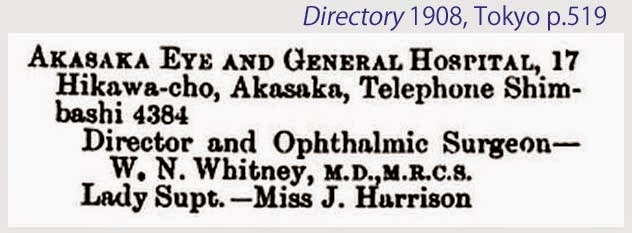
1908: Akasaka Eye and General Hospital
The name has became more simple.


Akasaka Hospital

1917: Akasaka Hospital
No more Willis. William Russell Watson is the director. 


1920: Akasaka Hospital
No doctor's name is mentioned. 


1922: Akasaka Hospital
George Braithwaite, Willis' brother-in-law is an honorable treasurer. The Directory said that there were two of hospital for foreigners in Tokyo, Akasaka and St. Luke's.


In Japanese

 赤坂病院・赤阪病院 

Then, how about Japanese name of the hospital?
It seems that they were always called Akasaka Hospital 赤坂病院 in Japanese. The following image is from an ad at a newspaper, dated 15 December 1892. It reads: 
電話九六九番 内外國醫學士出張
診察自前八時至十一時 日曜休 赤坂區氷川町 赤坂病院
[ Telephone 969 / Doctors holding degrees of in and outside Japan make house calls / hours eight to eleven except Sunday / Akasaka Hikawa-cho Akasaka Hospital ]


出典:明治25年12月15日付東京朝日新聞朝刊6頁

Nothing mentioned about what kind of examination they offered, though, they made house calls. Tne next image is from a medical guidebook of Tokyo, Tōto no Kyōrin, publised in 1902.


田中義一 編『東都の杏林』医海時報社 1902 / pp.26
http://dl.ndl.go.jp/info:ndljp/pid/778437/32

赤坂區
●赤阪病院 氷川町十七番地 新橋九六九
院長ドクトル ホイトニー氏、内外科。
[ Akasaka ward / Akasaka Hospital /  17 Hikawa-cho Akasaka / Shimbashi 969 / Director Dr. Whitney / medicine and surgery ]

The hospital name described 「赤」 not 「赤」 (阪 and 坂 have the same pronounciation). Is this a misprint? I'm not sure. 「内外科」 meas “medicine and surgery”, there is no mention of ophthalmology. I think this guidebook is not very trustworthy.

The last image I am mentioning is from a telephone directory of Tokyo published in 1926.


出典:東京電話番号簿(大正15年5月1日現在) 「あ」の項目のPDF

It reads 「赤坂病院 青山36-5406 赤、氷川、五」. Pay attention to the address is 5 Hikawa-cho, not 17 Hikawa-cho. 5 Hikawa-cho, just around the corner of no. 17, was where George Braithwaite lived then.


Images are cut out and processed by the editor.
Thanks for the those prepared the original data on the net.


Last updated 25 Jan. 2015

2014-12-22

Foreigners in Tokyo 1880s

How many foreigners did reside in Japan in the late nineteenth century?

On 1876, the centennial year of America's Independence, Willis's sister Clara wrote on her diary that there was only sixty two Americans then [29 June 1876].

Fred Victor Dickins (1838-1915) of University of London wrote that:
The total number of foreign residents [in Japan], exclusive of Chinese, was estimated in 1882 at 2650, of whom 1200 were of British nationality. In 1890 the number had increased to 3260, of which 1400 were British subjects.* 
    * The Chinese have steadily increased in number. In 1877 there were only 2107 Chinese residents in Japan, in 1879 there were 3649.  
[ The Life of Sir Harry Parkes, Vol.2, London: Macmillan and Co.,1894, p.445 ]

I've found an article on The British Friend, 1st Month 2nd, 1888, p.7.
Japan.— According to the latest returns of foreigners residing in Japan, there are 592 Americans, 343 Germans, 198 Frenchmen, and 1,423 British. Of foreigners in Government employ there are 27 Germans, 17 Americans, 8 Frenchmen, 8 Italians, 6 Dutchmen, and 68 Englishmen.
Yes, British was the majority of foreigners.
Willis was one of 17 Americans on the returns of the above.

As for Yokohama, a Professor R. H. Plummer, who visited Japan in 1888 wrote that “Yokohama is the chief seaport of the empire, with a population about 85,000, of whom 1200 are foreigners who have a limited district set apart for their purposes. ” [The Southern California Practitioner, April 1889, p.170]

I've found another figure about foreigners in Directory. See the following table. Pay particular attention to Yokohama (Kanagawa prefecture) was excluded.
Population data are based on the official web site of Tokyo prefecture  [人口の動き].


yearpopulation of Tokyoforeign residents in Tokyo
1875932,458――
1877890,681some 300 [Directory 1879, Tokyo p.390
18851,163,400about 300 [Directory 1889, Tokyo p.527
18911,333,900807* [Directory 1892, Tokyo pp.11-12
19001,947,300――
19102,732,000――
* on June 1891. 214 British, 204 American, 133 German.


Some 300 or 800 of foreigners in Tokyo in the 1880s ― I image that they could know each other, especially among English speaking people. It's a small world.

Note: Tokyo [東京 Tokei, Tokio] became the capital city of Japan when Meiji period [明治時代 1868-1912] started, however, it was not a prefecture of the largest population in Japan in the 1880s. In 1888 census, the largest was Niigata 新潟,  the second Hyōgo 兵庫,  the third Aichi 愛知 and the fourth Tokyo.


Last updated 18 Jan. 2015

2014-12-19

Arrival 1875

The Whitney family set foot in Japan firstly on 3rd August 1875.
The member was:


William Cogswell Whitney  aged 50
Anna Lavina Whitney (née Mockridge)  41
Willis Norton Whitney 19 
Clara A. Whitney 14
Adelaide Norton Whitney 7


I've found a newspaper article mentioned their departure from San Francisco. The family of W. H. Whitney [sic] was among the passengers list of Oceanic.


Pacific Appeal, 17 July 1875, p.1.

Here it is an evidence of their arrival.


The Japan Weekly Mail, 7 Aug, 1875, p.686.

ARRIVALS.
Aug. 3, Oceanic, British steamer, Jennings, 2,700, from San Francisco,...
PASSENGERS.
Per Oceanic from San Francisco. ― Mr. and Mrs W. C. Whitney, M. C. Whitney, ... W. N. Whitney,...

“M. C. Whitney” must be a misprint for “C. A. Whitney” or “Misses C. and A. Whitney.” I suppose that Adelaide was too little to be mentioned.


Images are cut out and processed by the editor.
Thanks for the those prepared the original data on the net.


Last updated 13 November 2016,
Edited 06 Jan. 2015

2014-12-16

Interpreter Willis 2

Willis was a capable interpreter of the Legation.  He was always punctual and diligent in his duties and working hard during office hours (9 a.m. to 4 p.m.), always ready with kindly advice and help [Remi1933: pp.46-48].

One of the Legation several events of National importance took place while Willis held his post as interpreter, was the promulgation of the New Japan Constitution on 11th February 1889. A state Banquet was held in the evening,  which he attended. The following letter written by the US minister Swift mentions that.
Mr. Swift to Mr. Blaine (John F. Swift)
No.80. Legation of the United States, Tokio, January 3, 1890 (Received January 29.)

SIR : I have the honor to transmit herewith a copy of a communication from His Excellency Viscount Aoki [*1], His Imperial Japanese Majesty's minister for foreign affairs, addressed to me, which, as you will observe, requests me to transmit to each of certain American citizens therein named a medal and brevet commemorative of the promulgation, in February, 1889, of the imperial Japanese constitution, and of the fact that the said American citizens were present on that occasion and witnessed the ceremony.
The American citizens to whom I am requested to forward these medals and brevets are my predecessor in this mission, ex-Governor R. B. Hubbard; Mr. F. S. Mansfield, late secretary of legation, both now living in Texas; Mr. Edwin Dun, present secretary of this legation; and
Dr. Whitney, interpreter.
I may also mention that they were present at the ceremony as representatives of the United States.
Inasmuch as both Governor Hubbard and Mr. Mansfield have ceased to hold any diplomatic or other official relation with the Japanese Government, there appears no reason, so far as I can see, why the acceptance or refusal of the articles thus offered them may not be left to their own discretion, at least so far as I am concerned. For that reason, and in view of their recent position at this legation, I felt called upon, as a matter of courtesy due to my predecessor and late secretary, to forward the medals, etc., direct to them without comment or suggestion, which I did. I trust this action may not meet with your disapproval.
Whether the medal referred to is such a present or other gift as falls within the inhibition of section 1751 of the Revised Statutes is a question that I do not feel called upon to decide, but refer to yourself for instructions in future cases, for in the case of Governor Hubbard and Mr. Mansfield I have already acted, at least as to sending the medals.
It is true, however, that in case they accept or reject I shall hereafter be called upon officially to notify the Government of His Imperial Japanese Majesty of the fact. If it be such inhibited gift, it is quite possible that I am wrong in forwarding it to any citizen who by law can not accept it.
I was recently requested by His Imperial Majesty's Government to forward to a gentleman in the United States consular service in Japan a medal recognizing his action in jumping into the sea and, at some risk to his own life, rescuing a drowning Japanese subject. I forwarded the article to the gentleman without offering any opinion as to his right to accept it, but leaving that question to himself. I did so, because I thought the medal issued under such circumstances hardly fell within the restriction of the statute; Nor, except upon a very strict construction of the statute, perhaps, does it in the medal commemorative of the new constitution which I have forwarded to Governor Hubbard and Mr. Mansfield.
But it is exceedingly probable that the question is not a new one to the Department, and that it may have been long since settled one way or the other.
Whether the United States minister here can properly in any case be the medium of communication and transmission of any kind of testimonial between the Government of Japan and citizens of the United States is a question in my mind not entirely free from doubt, and if there be a settled rule, I should be glad to know and will cheerfully follow it.
Another question I wish specially to be instructed upon. You will observe that the other citizens to whom these medals have been issued are Mr. Dun and
Dr. Whitney. These articles are now in this legation. Mr. Dun, being actually secretary of this legation, it follows that the objection to his accepting, if any there be, grows out of the question as to whether this commemorative medal is such a present, emolument, favor, etc., as is prohibited United States diplomatic officers by the Constitution and laws of the country and especially section 1751 of the Revised Statutes. If so, it would seem as a logical result that I have no right to offer it to them, but should return it to the foreign office with a statement of the reasons. The same may be, and probably is, the case as to Dr. Whitney's right to accept the medal issued to him. It is possible Dr. Whitney, who is merely interpreter to this legation, and not technically a secretary, may not stand in precisely the same position in the premises with Mr. Dun, although the reason for the rule would certainly seem to apply as strongly in his case as in that of any other diplomatic employé. Yet I separate them and ask for instructions in each case, and also in Governor Hubbard's.
I have, etc.

JOHN F. SWIFT.
[The Executive Documents of the House of Representatives for the Second Session of the Fifty-First Congress. 1890-'91.
Washington: Government Printing Office, 1891, pp.575-576.]

http://babel.hathitrust.org/cgi/pt?id=hvd.hj1gik;view=1up;seq=683

In those days all foreign travelers in the interior had to have passports and the making out of these was one part of his work. Therefore, missionaries from the USA needed his help, and Willis was ready to assist them in carrying the gospel over Japan. For that reason, he compiled the A Concise Dictionary of the Principal Roads, Chief Towns and Villages of Japan, and Index of Chinese Characters in Hepburn's Dictionary arranged according to their radicals, which was two of indispensable books for mission works at the time.
(image: https://archive.org/details/indexofchinesech00whitrich)

Rev. Edwin Munsell Bliss commented about connections between missionaries and official position:
There is another connection with the local government, however, which often works for good. From their superior education and ability missionaries are often appointed to some official position. Dr. Verbeck [*2] was for some time a state official of Japan. ... Others have served for a time as diplomatic agent of the home government, like S. Wells Williams. Dr. Whitney, of Tokyo, as Secretary of the American Legation, is in a position to use his official as well as medical services for the benefit of Christianity. Such positions often prepare the way for the gospel, and commend it to strangers.
[ The Encyclopaedia of Missions, New York: Funk & Wagnalls, 1891, p.277.

http://babel.hathitrust.org/cgi/pt?id=njp.32101068101037;view=1up;seq=309 ]

Willis looked upon his post at the Legation as given him by the Lord to enable him to carry on the Akasaka Hospital and to support his family [Remi1933: p.48]. It is clear that without regular income from the Legation, he could have not got married to Mary Caroline Braithwaite, nor took care of his hospital.
After twelve years of service,Willis resigned his post in 1895.
The reluctance of the Department of State to accept his resignation is shown in the following letter. 
COPY OF LETTER FROM THE DEPARTMENT OF STATE,WASHINGTON.
Aug, 28, 1895.

Dr. Willis Norton Whitney,
Intrepreter [sic] of Legation, Tokio,
   now at London, England.
Sir,
    I have today informed Mr. Dunn that your resignation is accepted, and in saying the same to you directly I take occasion to express the sincere regret which, this Department feels that personal considerations prevent your longer continuance in an office which you have filled with entire acceptability. Knowing how important it is to the interest of our representative service in the eastern countries that the Legation's interpreter should not only be versed in the language of the people, but bring to the performance of his duties a high degree of intelligence and earnest attention to the duties of his office and knowing how well you have filled these conditions during the twelve years that you have been associated with the public service,it is due alike to you and to the Department to place on record the deep regret here felt that you are about to retire from your honourable and confidential post.
          I am Sir,
               Your obedient servant,
                      (Signed) Alney A. Adee.[*3]
                                        Acting Secretary. 
[Remi1933: pp.45-46]

[ Notes by the editor ]
*1 青木周蔵 AOKI Shuzo (1844-1914), diplomat and Foreign Minister. http://en.wikipedia.org/wiki/Aoki_Sh%C5%ABz%C5%8D 
*2 Guido Herman Fridolin Verbeck フルベッキ, ヴァーベック (1830-1898),  Dutch political advisor, educator and missionary of the Dutch Reformed Church. Died in Tokyo and was buried near Willis' mother.  http://en.wikipedia.org/wiki/Guido_Verbeck  
*3 Alvey Augustus Adee (1842-1924), Second Assistant Secretary of State 1886-1924.  [ Office of the Historian ]

Images are cut out and processed by the editor.
Thanks for the those prepared the original data on the net.


Last updated 04 Jan. 2015