ラベル obituary の投稿を表示しています。 すべての投稿を表示

2017-09-17

Obituary - Willis by a Friend

クエーカーの雑誌に掲載されたウィリスの追悼記事です。日本に帰国かなわず、いってみれば英国で不本意な「客死」をした彼ですが、当地の友会徒のあいだでどう認識されていたかがわかります。

The following obituary is from The Annual Monitor for 1919-20, Being an Obituary of Members of the Society of Friends in Great Britain and Ireland, from October 1st, 1917, to September 30th, 1919, London: Headley Brothers, 1920, pp. 296-300.
https://archive.org/stream/annualmonitoror191920alex#page/296/mode/2up


DR. WILLIS N. WHITNEY. 

The peaceful passing away of Dr. Willis N. Whitney, of Tokyo, Japan, at 2, West Bar, Banbury, on October 26th, 1918, recalls the memory of nearly thirty fruitful years of missionary labour in Japan. 


“Dr. Whitney was born at Newark, New Jersey, in 1855 *1. His father, the principal of a Business College in that city, was one of those who responded to the call for American educators to help in shaping the new destinies of Japan, and Dr. Whitney, then a youth of seventeen, accompanied his family to Tokyo in 1872 [sic] *2. His mother, a devoted Christian woman, seems to have exerted the strongest influence on his young life, and he resolved to study medicine so as to fit himself for carrying the Gospel to the Japanese. He was the first foreign student of medicine at the University of Tokyo in 1877, afterwards finishing his course and obtaining his medical degree at the University of Pennsylvania. His knowledge of the Japanese people and their language peculiarly fitted him for this work. 


His family on their first arrival had been warmly welcomed, and given a home on the private estate of Count Katsu *3, one of the enlightened statesmen to whom Japan owed so much in the first days of opening her doors to Western civilisation. In this home in the heart of the Japanese capital, the Whitney family continued to reside. After the death of his parents, the Japanese wished to erect a memorial to his mother and at Dr. Whitney's suggestion this took the shape of a free Dispensary. Three years later, in 1886, shortly after his marriage to a daughter of the late Joseph Bevan Braithwaite, a small Cottage Hospital was built with the help of additional funds raised in England and America and a permanent work begun. 


In the meantime Dr. Whitney had accepted the post of Interpreter to the United States Legation in Japan, a post which he filled for twelve years, only giving it up then in order to devote his whole strength to the more direct Gospel work. His position at the Legation brought him into contact with a wide circle both of Japanese and foreigners, and his home became a wonderful centre of Christian life and helpfulness, to which Japanese and foreigners alike resorted for spiritual and physical help. Many circumstances of early education helped to qualify Dr. Whitney for his life work, but most of all his absorbing love for his Saviour and his desire to be used in bringing other souls to Him gave a meaning to all the little details of everyday life. He truly lived his religion, and so his life became a living epistle known and read of all men. Though intimately acquainted with some of the richest Japanese families, his heart went out particularly to the poorer classes, and his time and strength were chiefly given to these. 


The Bible was to him very precious, and he was ever on the watch for opportunities of bringing it into the hands of the people. At one time he organised a house-to-house distribution of a Gospel or portion in Tokyo, Yokohama and five or six other leading cities of the Empire. The city of Tokyo alone, where he lived, contained a population of more than two million. 


Side by side with the Akasaka hospital, and claiming an equal share of his interest and labour, were the establishment and direction of the Japan Scripture Union, a branch of the Children's Special Service Mission in London. For many years the membership averaged 11,000 to 12,000, with about 800 branches scattered throughout the Empire, and the work is still vigorously carried on. In 1909 the twenty-fifth anniversary of the founding of the Akasaka Hospital was celebrated. The Japan Advertiser published a most sympathetic article from which the following sentence is quoted  : “Strangers who visited the Hospital for the first time went away much impressed by the noble work of charity that is carried on within the walls of the modest little building. To all present there was truth in the remark of a poor patient who had been successfully treated,  ‘I have often heard of Akasaka Hospital and thought on the outside it looked like any other hospital, but inside it is heaven.’” It was only in the last years of his life in Japan that Dr. Whitney reluctantly accepted a small honorarium for his abundant labours at the Hospital. His own professional work was heavy, and his powers were taxed to the utmost by the constant claims upon him. This was certainly true of the last years of his work in Japan. 


In 1911 he and his wife came to England with their youngest son, the other four children being already there. They were fully expecting to return after a year's furlough to the land of their adoption, and he had no idea that he was leaving his loved work for the last time, but so it proved, for, after a few months, the long overstrain showed itself in complete breakdown. After a prolonged time of rest, he partially recovered and was able to enjoy outdoor life among the plants and flowers. During all his time of physical weakness he never ceased to take an interest in the sick and needy, and latterly one of his great pleasures was visiting in the cottages around, where he made many friends among the people. They realised his sympathy with them, and many testimonies have been received since his death showing how he was loved. His was a large-hearted Christianity, which reached out to seek fellowship with everyone who loved his Lord. — The Friend


[Notes by the editor]

*1 His sister Clara strangely wrote on her diary that Willis became 23 years old at his birthday in 1876 [Kodansha ed., 1976, Vol.1, p.129]. This means he was born in 1853. 
Actually he was born on 18 October 1854. 
*2 The Whitney family arrived Yokohama on 5 August 1875. Willis was 20 years old then.
*3 Count Katsu : Katsu Kaishu 勝海舟 (1823-1899), Japanese naval officer and statesman. 
  See http://www.ndl.go.jp/portrait/e/datas/51.html
         https://www.jref.com/articles/katsu-kaishu.84/


Thanks for the those prepared the original data on the net.


*          *          *          *

This obituary has rather short of concrete facts, however, showing how he was regarded by British Quakers. The name of his wife, Mary Caroline was not shown, but “a daughter of the late Joseph Bevan Braithwaite”.


Staff of Akasaka Hospital at the entrance in 1900's.
photo from 渋沢輝二郎『海舟とホイットニー――ある外国人宣教師の記録』
東京: ティビーエス・ブリタニカ, 1981, p.70.
Charles Lloyd Whitney, born 23 Feb. 1898 at Tokyo
was sitting between Dr & Mrs Whitney


Last updated on 08 Nov. 2017

2016-11-13

Adelaide Norton Whitney - 1

函館外国人墓地に眠るウィリスの妹、アデレード・ノートン・ホイットニーのお話です。日本語版はこちらからどうぞ

Adelaide N. Whitney
講談社版『クララの明治日記(上)』
カバージャケットより(部分)

If you look for the image of foreigners' cemetery in Hakodate, Hokkaido, Japan on a search engine, you could find a grave with a low white cross near a hydrangea bush among hundreds of photos, like the following.


This is the final rest place for Adelaide Norton Lang, née Whitney, younger sister of Willis Norton Whitney.


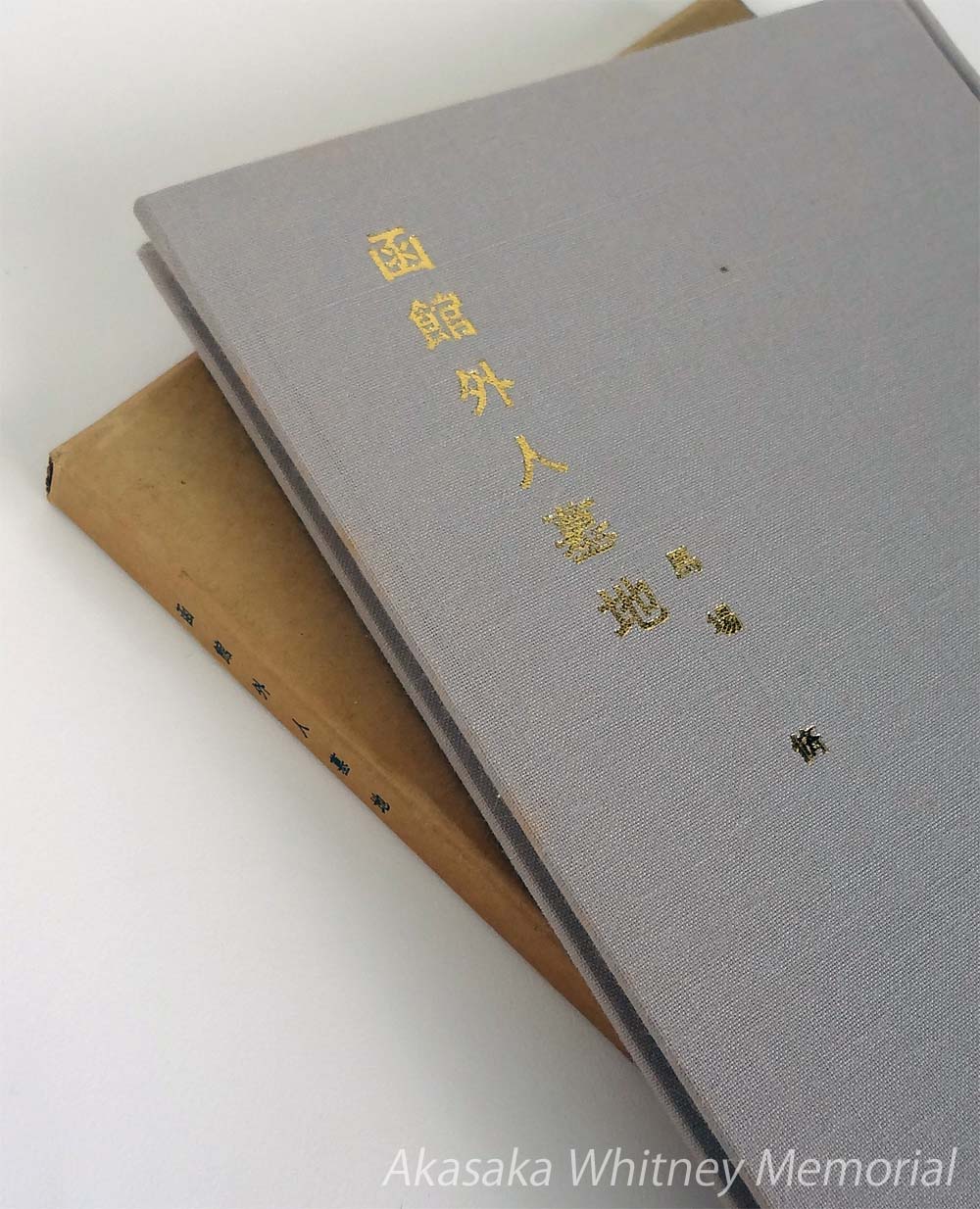
You might think why the cross has not a good balance - the vertical bar is too short, even as a Greek cross? This mystery was solved when I found a book Hakodate Gaijin Bochi [函館外人墓地, Hakodate Foreigners' Cemetery] written by BABA Osamu, published in 1975.

Mr BABA (1892-1979), a well-known local historian, a dentist, who was born and raised in Hakodate city, compiled the fruits of years of research on buried non-Japanese-persons in Hakodate into a book. This is a great, unprecedented work.


『函館外人墓地』馬場脩 著/図書裡会 1975
  http://search.library.utoronto.ca/details?4036709&uuid=3cbbe878-8f0f-4efa-944f-cbde0a741e49

Addie's gravestone had fell a victim of vandalism, and the cross went missing for a long while. Mr BABA, an Orthodox Christian, found the cross in 1972 and the Anglican Church in Hakodate [Hakodate St. John Church 函館聖ヨハネ教会] restored the grave a few years before the book published.


『函館外人墓地』 p.22 より


ADELAIDE NORTON LANG
THE BELOVED WIFE OF
REV. D. M. LANG, C. M. S.
WHO DIED AT HAKODATE
OCTOBER 1ST 1896
AGED 26 YEARS

“SO HE GIVETH HIS BELOVED SLEEP”


Hakodate St John Church put a metal plate
for Addie, just beside the grave.

Photo taken in 2016.

Mr BABA wrote that “nothing was known about this priest's wife” [p.59], however, I can add something.

Adelaide Norton was born 17 June 1868 at Newark, NJ, as the third and youngest child of Mr & Mrs Whitney. She was 7 years old when her family arrived Japan on August 1875. On 17 January 1893 Addie married a Scottish missionary, Rev. David Marshall Lang (1862-1946) of CMS at St Andrews Church, Tokyo. She passed away just after she delivered her first-born on 1 October 1896, at the age of 28, not 26.


Dr. Whitney's younger sister had married a missionary of the Church Missionary Society, Rev. David M. Lang and they resided at Hakodate. Four years later, and only a week or two after our return from furlough in 1896 the news came to us by telegram that a son was born but the dear mother had died about two hours after. On hearing this Dr. Whitney immediately started for Hakodate, with a sorrowful heart, and came back five days later bringing the beautiful motherless boy with him for me to take care of. He was with us for six months and then an opportunity offered to send him to Mr. Lang's sister in London, where he was brought up. [ Remi1933, p.55 ]

The son was baptized David Marshall after his father, was grown up in England. He became a medical doctor as his uncle Willis, had a practice at Bath and died on 16 August 1978. His eldest son, born on 6 May 1924 was named also David Marshall Lang, became a professor of Caucasian Studies, University of London.

I felt so happy when I had found Professor Lang's son lives in London  — poor Addie's great-grandson IS alive! What I might tell his family is, the small corner of a foreign field your great-grandmother resting is very beautiful place with a fine view. Her life was short, but was blessed.


The following is her obituary, written by her husband.
Mrs. D. Marshall Lang. 
Adelaide Norton Lang, wife of Rev. D. M. Lang, M. A. of the Church Mission Society, who died at Hakodate, October 1st. 1896, was the daughter of Prof. W. C. Whitney of Newark, New Jersey, U. S. In 1875 (when she was only 6 [sic] years old) her father was invited to found a Commercial College in Japan. Five years later a visit was paid to England, and while there she became interested in the Scripture Union; so on her return she endeavoured to start a branch in Japan. Through the influence of Mr. Tsuda Sen [*1] this was begun, and the number of members rapidly increased until now there are over 11,000 with 460 secretaries and branches in all parts of the Empire. For a while Mrs. Lang was teacher of English in the Peeress' School [*2] in Tokyo, until her marriage in January 1893. Since then first at Osaka, then at Hamada [*3], and lastly at Hakodate, she truly helped the work of her husband for the spread of the Saviour's kingdom in Japan. Whether visiting Kushiro and other outstations with him, or preparing Bible Women for their work and herself holding women's meetings, she was ever labouring for the good of those around her. 
Her long residence in Japan gave her a command of the language rarely attained, which she always used for God's glory. By translating the life of Catherine Tait [*4] and in other ways she also tried to impress upon the mothers of Japan the duty and beauty of a Christian Home. Her death, at a time when a wider sphere of usefulness seemed opening out for her, was a great loss to the work, but her service is only continued in a higher and more perfect sphere for the Master she loved and served below. D. M. L.

— Proceedings of the General Conference of Protestant Missionaries in Japan,  p.703.
[ Notes by the editor ]
*1 TSUDA Sen : 津田仙 1837-1908, a Methodist educator, agriculturist. Father of Miss TSUDA Umeko, founder of Tsuda College [津田塾大学].
*2 Peeress' School in Tokyo : 女子学習院. See History of Gakushuin School
*3 Hamada : 石見国浜田町〔現・島根県浜田市〕 Now Hamada City, Shimane.
*4 Catherine Tait : 1819-1878, wife of Archibald Tait (1811-1882), Archbishop of Canterbury (1868-1882).

Rev. D. M. Lang got remarried with his Scotland-born maternal first cousin in 1902 and had another son, who became a school teacher. He continued his missionary work on Hokkaido in Japan with his second wife until 1920. He died in the first day of 1946, aged 83, as a rector of Fillingham, Lincolnshire, England. Incidentally, Rt. Rev. William Cosmo Gordon Lang (1864-1945), Archbishop of Canterbury (1928–1942) was his paternal first cousin.


Images are cut out and processed by the editor.
Thanks for the those prepared the original data on the net.
Images of “Kurihon” stamped were photos taken by me,
for the Japanese edition of my blog.


Last updated 27 November 2016

2014-12-11

Obituary - Willis Norton Whitney 1918, with notes

The Japan Evangelist に掲載されたウィリス追悼記事を、注釈つきで紹介します。渋沢輝二郎『海舟とホイットニー――ある外国人宣教師の記録』(ティビーエス・ブリタニカ 1981)の pp.48-53 に載っている翻訳の元記事です。
Japan Christian Year Book にある記事よりも掲載が早く、また分量が多く、三田の基督友会伝道所における記念会の様子も描かれています。
無記名ですが、著者は義弟のジョージ・ブレイスウェイトと思われます。


The following obituary was published on the December 1918 issue of 
The Japan Evangelist, (A Journal of Christian Work in Japan, published monthly in Tokyo). Though it was written anonymously, George Braithwaite must have been the contributor.


The Japan Evangelist, Vol.XXV, December 1918, no.11.
pp.412-13.

DR. WILLIS NORTON WHITNEY 1855-1918
     Our dear friend Dr. Willis Norton Whitney was born at Newark, New Jersey, October 18th, 1855. There were two sisters, both of whom spent many years in Japan. The younger one [*1], who was instrumental in founding the Scripture Union in Japan, lies buried at Hakodate. She was the wife or the Rev. David Lang.
     Dr. Whitney's parents were earnest, God-fearing people with no thought of going abroad until one day they met two or three Japanese, and very soon felt that their Master would have them give up their happy home at Newark and go and live for him in what was then, forty-three years ago, the far-off land of Japan, as self-supporting workers, that some at least of the Japanese people might have the opportunity of seeing what a Christian home is like.
     Obedient to this divine call the family reached Tokyo in 1875. The father became a teacher in what is now the Higher Commercial School. The son, Willis N. Whitney, who was then twenty years old, studied medicine for a while at what has since become the Tokyo Imperial University, and was one of the first foreigners to enroll in that institution. For some time he was teacher of English, Chemistry and Physics at the Middle Normal School at Kanazawa. The late Count Katsu rendered much kind help to the whole family at this time and during the period of their stay in Japan.
     After some years Willis N. Whitney returned to America with his parents for a visit. While there he resumed his medical studies at the University of Pennsylvania, and continued until his graduation in 1881. He afterward took British medical degrees [*2]. The family left America on their return journey to Japan about 1881 going by way of London, where the father died, leaving his son responsible for the whole support of the family. They continued their journey to Tokyo, but the mother's health soon failed and she passed away in Akasaka, Tokyo, in the spring of 1883. Willis N. Whitney's devotion to his mother during this period deeply impressed the Japanese and did much to remove the mistaken impression that Christianity does not teach due respect for parents.
     In 1883 Dr. Whitney became interpreter at the American Legation in Tokyo. This position, which he held for more than twelve years, brought him into touch with many of the leading Japanese statesmen of the middle Meiji period.     On December 9th [sic *3] 1885, Dr. Whitney was married to Mary C., daughter of J. Bevan and Martha Braithwaite of London. To them were born seven children, five of whom are still living. One son is in India, one in New York and two in France. The only daughter lives in Ireland. Dr. and Mrs. Whitney for the past few years lived at the old home of Mrs. Whitney's mother at Banbury, England where Dr. Whitney passed away.     Dr. Willis Norton Whitney was an indefatigable worker who seemed to be always thinking of new and larger plans for the spread of the Gospel of Christ. He founded the Akasaka Hospital, Tokyo, in 1889, in memory of his mother and continued as its Foreign Director until he left Japan for the last time in 1911. In 1895 he resigned his position at the American Legation that he might give his mornings to the Hospital and be free to devote his whole life to Christian work. In addition to his Hospital responsibilities, and his private medical practice, he devoted much time and thought to the Scripture Union work, the Police Mission, the Railway Mission and the Post and Telegraph Mission, all of which he founded. As these missions grew they were transferred to other hands some years before he left Japan. With so many interests on hand his time was very full, but he had so learned of his Master that he seemed ever at leisure for those who sought his advice or help. Although he often worked till after midnight he would be up at five the next morning to try and secure a quiet hour with his Lord before the regular work of the day began, 
     Dr. Whitney's service to the cause of medicine in Japan is indicated by the fact that from 1896 to 1906 he was Vice-President of the Society for the Advancement of Medical Science in Japan. His large interests outside of his medical profession are evidenced by some of the following publications: “ Blood Changes in Erysipelas,” 1881; Dictionary of Roads and Chief Towns in Japan, 1885; “Notes on the Medical History of Japan,” Asiatic Society Transactions, 1885; Index of Chinese Characters in Hepburn's Dictionary. 1888; Editorials in English Department of the Japanese Sei-I Kwai Medical Journal; Correspondence and Contributions to the Philadelphia “Medical Times” and the New York “Medical Record.”[*4]
     Dr. and Mrs. Whitney left Japan in April, 1911, hoping to be back, before the end of the year, but he had a serious breakdown soon after reaching London, followed about two years ago by a slight apopletic [sic. apoplectic] stroke, from which he never fully recovered. The cable received in Tokyo by George Braithwaite, brother of Mrs. Whitney, reads; “Willis passed peacefully away October 27th, funeral 29th,” His age was sixty-three years and nine days.
     His was a cheery Christianity. By the grace of God he wonderfully enabled to overcome his natural tendency to despondency and to carry the sunshine of the Lord's presence wherever he went. While his medical duties often prevented his regular attendance at the meetings of the Society of Friends, of which he was devoted member and recorded minister [*5], it was not at all unusual, during their long. residence in Tokyo, Dr. Whitney and his family to walk over from their home in Akasaka to Friends' meeting in Mita [*6]. He was remarkably faithful in passing on to others any fresh blessings which he had received. Extremely lenient with the shortcoming and failings of others, he was very strict with himself. He held a very low estimate of his attainments, in fact so humble was he that one or his greatest surprises may be when he finds up yonder how much blessing and cheer he was enabled to bring to so many who were well night ready to faint because of the way.
      “For I was an hungered, and ye gave me meat; I was thirsty, and ye gave me drink; I was a stranger, and ye took me in; naked, and ye clothed me; I was sick, and ye visited me; I was in prison, and ye came unto me.” [*7]
MEMORIAL MEETING
       Following the receipt of a cable announcing the death of Dr. Willis Norton Whitney, well known to the Japanese and foreign communities in Japan, his friends arranged for a memorial meeting which was held at the Friends' Meeting House, 30 Koun Cho, Mita [*6], Tokyo, at 3-30 P.M., November 12th.
     The house was well filled with Japanese and foreigners, many of whom had been intimately associated with Dr. Whitney. After the opening, period of worship, sketches of Dr. Whitney's life were given in English and Japanese by the two Chairmen, Dr. Inazo Nitobe [*8] and Mr. Gurney Binford [*9]. Of the many institutions in which Dr. Whitney had a large share in founding and supporting, the following were represented by appropriate messages, bearing witness to the power of a life dominated by the pure motive of service; The Akasaka Hospital, Mr. S. Sumiya [*10]; The Scripture Union, Mr. S. Mimaki [*11]. The medical world of Japan was represented in person by a message of appreciation from Dr. Shoho Kawakami [*12] and by a letter from Dr. K. Takata [*13].


[ Notes by the editor ]

*1 Adelaide Norton Whitney, was married to Fr. David Marshall Lang on 17 Jan. 1893, died on 1 Oct. 1896, aged 26.
*2 Sic. He did not actually take British medical degrees.
*3 29th is correct.
*4 About his publications, see the notes of this page
*5 He was a minister of Baltimore Yearly Meeting.
*6 当時の住所で芝区三田功運町三十番地 聖坂友会伝道所
*7 Matthew 25:35-36.
*8 新渡戸稲造(NITOBE Inazō にとべ いなぞう)1862-1933 Educator, agricultural economist. A member of the Religious Society of Friends.
*9 Gurney Binford  1865-1951 Quaker minister from Kansas, came to Japan with his wife Elizabeth in 1893. Worked mainly Ibaraki prefecture after 1899. Back to USA in 1936.
*10 Sic. M. Sumiya is likely. 隅谷巳三郎(SUMIYA Misaburō すみや みさぶろう)1869-1945  Came to known Christ at Willis' Sunday School. He became the person in charge of Japan Book and Tract Society, after George Braithwaite. 
*11 御牧碩太郎(MIMAKI Sekitarō みまき せきたろう 1870-1949
*12 川上昌保(KAWAKAMI Shōho かわかみ しょうほ) 1859-?   
*13 高田畊安(TAKATA Kōan たかた こうあん) 1861-1945 Christian doctor, founder of Nankoin 南湖院 Sanatorium. Married to Count Katsu's granddaughter.

end of the notes.

Another obituary published in the next year at Japan Christian Year Book seems to be an abridged and revised edition of the above. See this page.


今回、元記事を確認してわかりましたが、上記の記事は「弔辞を述べた」で終わっています。『海舟とホイットニー』p.52、左から6行目の「ウィリスは早くから日本語に……」以下は、追悼記事の一部ではありません。まぎらわしいのでご注意ください。

記事の複写にご協力くださった方に、心より感謝します。


Last updated 11 Jan. 2015

2014-12-10

Obituary - Willis Norton Whitney 1919

英語版の『日本基督教年鑑』に記載されたウィリス追悼記事のご紹介。
著者は義弟のジョージ・ブレイスウェイト。

The following obituary was published on the 1919 issue of The Japan Christian Year Book. The contributor, George Braithwaite was Willis' brother-in-law.


The Christian Movement in the Japanese Empire 
including Korea and Formosa, A Year Book For 1919
Seventeenth Annual Issue, 
Published for the Conference of Federated Missions, Japan, 1919, 
https://archive.org/stream/thejapanchristia17unknuoft#page/274/mode/2up
pp.275-77.

JAPAN Part VIII / OBITUARIES
X. WILLIS NORTON WHITNEY, M. D. 
BY GEORGE BRAITHWAITE 
Dr. Willis Norton Whitney was born at Newark, New Jersey, October 18th, 1855. He had two sisters, both of whom spent many years in Japan. The younger one, who was instrumental in founding the Japanese Branch of the Scripture Union, lies buried at Hakodate. She was the wife of the Rev. David M. Lang of the C. M. S. 

Dr. Whitney's parents were earnest, God-fearing people with no thought of going abroad until one day they met two or three Japanese and very soon felt that their Master would have them give up their happy home at Newark and go and live for Him in what was then, forty-four years ago, the far-off land of Japan, not in connection with any Missionary Society but as self-supporting workers, so that some at least of the Japanese people might have the opportunity of seeing what a Christian home was like. Obedient to this divine call, the family reached Tokyo in 1875. The father became a teacher in what is now the Higher Commercial School. The son, Dr. Whitney, who was then about twenty, studied medicine at what has since become the Tokyo Imperial University, and was one of the first foreigners to enroll in that institution. For some time too he was teacher of English, Chemistry and Physiology at the Middle Normal School at Kanazawa. The late Count and Countess Katsu rendered much kind help to the whole family, not only at this time but also during the whole period of their stay in Japan. 


After some years Dr. Whitney returned to America with his parents for a visit. While there he resumed his medical studies at the University of Pennsylvania, these having been broken off when he went to Japan. He graduated from there in 1881. He afterwards took British medical degrees. The family left America about 1881 on their return journey to Japan, going by way of London, where the father died, leaving his son, the subject of this little sketch, responsible for the whole support of the family. They continued their journey to Tokyo, but the mother's health soon failed and she passed away in Akasaka, Tokyo, in the spring of 1883.

 Dr. Whitney's devotion to his mother during this period deeply impressed the Japanese and did much to remove the mistaken idea that Christianity did not teach due respect to parents. In 1883 Dr. Whitney became interpreter, at the American Legation in Tokyo. This position which he held for more than twelve years brought him into touch with many of the Japanese statesmen of the middle Meiji period. 

On December 29th, 1885, Dr. Whitney was married to Mary C., daughter of Joseph Bevan and Martha Braithwaite of London. To them were born seven children, five of whom are still living. One son is in Mesopotamia, one in New York, and two in France. The only daughter is married and lives in Ireland. 

Dr. Whitney was an indefatigable worker and one who seemed to be always thinking of new and larger plans for the spread of the Gospel of Christ. He founded the Akasaka Hospital in Tokyo in 1889 in memory of his mother and continued as its Foreign Director until he left Japan in 1911. In 1895 he resigned his position at the American Legation so that he might give his mornings to the Hospital and be free to devote his whole life to Christian work. In addition to his Hospital responsibilities and his private medical practice, he devoted much time and thought to the Scripture Union Work, the Police Mission, the Railway Mission and the Post and Telegraph Mission, all of which he greatly assisted in founding. 


His service to the cause of medicine in Japan is indicated by the fact that from 1896 to 1906 he was Vice-President of the Society for the Advancement of Medical Science in Japan. His large interests outside of his medical profession is evidenced by some of the following publications: “Blood Changes in Erysipelas,” 1881; “Dictionary of Roads and Chief Towns in Japan,” 1885; “Notes on the Medical History of Japan,” Asiatic Society Transactions, 1885; Index of Chinese Characters in Hepburn's Dictionary, 1888; Editorials in the English Department of the Japanese Se-I Kwai Medical Journal; Correspondence and Contributions to the Philadelphia Medical Times and the New York Medical Record. 


Dr. and Mrs. Whitney left Japan in April 1911, hoping to be back before the end of the year, but he had a serious breakdown soon after reaching London, followed about two years ago by a slight apoplectic stroke, from which he never fully recovered. The last eighteen months were spent at Mrs. Whitney's mother's old home at Banbury and were a time of much quiet enjoyment. 


His was a cheery Christianity. By the grace of God he was wonderfully enabled to overcome his natural tendency to despondency and to carry the sunshine of the Lord's presence wherever he went. He was a devoted member of the Society of Friends and a recorded minister, and it was not at all unusual for Dr. Whitney and his family throughout their long residence in Tokyo, to walk over from their home in Akasaka to the Friends meeting in Mita. He was remarkably faithful in passing on to others any fresh blessings which he himself had received. 

Images are cut out and processed by the editor.
Thanks for the those prepared the original data on the net.


Last updated 25 Jan. 2015