ラベル Akasaka Hospital の投稿を表示しています。 すべての投稿を表示

2017-09-16

Akasaka Hospital in 1900

1900年当時の赤坂病院の紹介文。ウィリス院長の手によるものです。

Willis reported about his hospital on General Conference of Protestant Missionaries in Japan, held in Tokyo on 24-31 October, 1900.

The following is from
Proceedings of the General Conference of Protestant Missionaries in Japan
Held in Tokyo October 24-31, 1900, Methodist Publishing House, Tokyo 1901, p.925

4. The Akasaka Hospital. 

W. Norton Whitney, M. D., Director. 
     The Akasaka Hospital was begun as a dispensary in 1882, the present building being erected in 1886, in memory of Mrs. A. L. Whitney, by Japanese and foreign contributions. The work is carried on as an independent, interdenominational Christian Medical Mission. Daily clinics for out-patients are held, which are attended by from 1,200 to 2,000 individuals annually, a total number of 7,000 to 8,000 visits. About 100 of these are treated as in-patients.
     All are required to pay as their circumstances permit, those unable to contribute anything being admitted free. The income from the patients amounts to about yen 2,000 a year, and the expenditure yen 3,500. The deficit is made up by donations from Japan, and abroad.
     Reading of the Scriptures, and prayer is conducted daily in the out-patients clinic room, and in the wards; and a Bible woman visits them in their homes.
     The staff consists of 3 physicians, 2 assistants, 5 nurses, 1 Bible woman, and a lady-superintendent.
     During the past year 18 conversions have been recorded. A Gospel Society has been organized to furnish temporary spiritual oversight of those of the patients who  become Christians, or desire to do so. 


Thanks for the those prepared the original data on the net.


*          *          *          *


photos of Akasaka Hospital from Remi 1930/1995


Last updated  06 Nov. 2017

2016-11-12

De Forest's 1898 report on Akasaka Hospital

Here is an ads of Akasaka Hospital, Tokyo, on January 1898.

『基督教名鑑(明治30年11月調査)』 教文館 1899 より
http://dl.ndl.go.jp/info:ndljp/pid/824326/157

The following is an article from October 1898 issue of the Missionary Herald, a monthly magazine containing the proceedings of the American Board [アメリカン・ボード] of Commissioners for Foreign Missions, with notes by the editor.


A Fine Christian Work in Tokyo. 
by Rev. J. H. Deforest, D.D., Sendai [仙台], Japan [*1].
If you should go to the great capital of Japan, Tokyo, you would see, as you ride over the vast city, the Greek cathedral high up on Suruga Dai [駿河台], the Catholic cathedral at the other end of the city [*2], spires of smaller Protestant churches here and there, an occasional Christian school, and frequent sign-boards with Chinese characters on them meaning, Christian Preaching Place.” These are some of the signs of missionary activity in Tokyo. But these are not all. Among the best pieces of missionary work in the whole East is that of Dr. W. N. Whitney, who belongs to no missionary society, but of whom it can be said that Christianity is his whole business and medicine is his means of carrying it on. 


When I first became acquainted with him, many years ago, he was the interpreter of the United States Legation, where he served through the terms of several ministers, publishing several works, among which is, “A Dictionary of the Principal Roads, Chief Towns, etc., of Japan.” But while carrying on his Legation work he established a Christian hospital near the Legation, in 1886, in memory of his sainted mother. We endeavor,” he says, to seek the spiritual good of the patients. Many of them have never heard of the true God and of our Saviour Jesus Christ. Not a few have, we thankfully believe, responded to the gospel message and have become true Christians. It seems to us that although there is undoubtedly a high standard of native medical skill in Japan, yet there is just as much need for medical mission work here as in London or New York.” 
One would think that the Legation and hospital work would be enough for an ordinary man, but Dr. Whitney is a big man and his manifold work corresponds to his size. He felt that he could do more. So, believing that the early Christians of Japan should be rooted and grounded in Bible truths, he started the Scripture Union Readings [*3] ― a printed schedule of daily readings for the entire year. Strange, is it not, that none of us regular missionaries should have thought of that? Its success is unique, for over 10,000 copies sell annually. Then, in order to make the readings more profitable, he started a monthly magazine in Japanese, with explanations of the daily lessons and other kindred matter, and this magazine has kept up as high a paid circulation as any other Christian periodical in Japan. 

Many times the question came up as to what his life work should be. Legation interpreter is a pretty sure berth, being a permanent appointment, with fair salary and good social position. But, with his medical education, he decided to leave official life and support his family and carry on his work by his medical practice. 
It is astonishing how many lines of work a Christian man with organizing power can evolve and carry out. Riding all day in the cars once to Sendai, he loaded his pockets with tracts and Bibles, and made it a point to see every station master and give him some Christian reading. Then he started the Railroad Mission. Miss Gillett [*4], from England, has come to assist in this branch. One of the pastors of the Presbyterian church [*5] has long been the superintendent of this work. Station masters, guards of trains, and other employees are being reached. He has added another Japanese monthly magazine to his work for this class of people, and it costs subscribers only twenty-four cents a year, and there are about six hundred subscribers. 
But the Doctor always seems to have room for one more endeavor in his heart. So he started another Christian magazine, this time for the police. I saw a report of this movement the other day which says there are over one hundred Christian policemen in Tokyo! A lady missionary who has recently come to Tokyo was called upon by one of these policemen. She was somewhat alarmed at an official call, lest she should have unwittingly violated some regulation. But her fears vanished when the policeman told her that he, too, was a Christian, and kneeled down with his sword by his side to ask God's protection on that home. 
Willis is at back row, second from the left.
Woman in the front row, far right, Miss Jessie Harrison

By this time it will not surprise you to know that the Doctor runs a Post and Telegraph Mission [*6] also, and all his work goes on in faith that God, who has put these things in his heart, will provide all necessary means. Friends in England and America who have seen his work, or learned about it through friends (for the Doctor is a kind of Quaker [*7]), assist to some extent, and Christian people, regardless of their shade of Christianity, gladly make occasional offerings; yet it pained the Doctor, at the beginning of this year, to have to cut off, from lack of funds, a gift of 1,500 copies of his Scripture Union Readings to the great prisons of Hokkaido, where a most interesting work of grace has been going on for several years.  
This is enough to introduce the man to you who may see this meager sketch. When you come to Tokyo, be' sure and call on Dr. W. N. Whitney, at the Akasaka Hospital. He may not be in, but you could leave your card and any filthy lucre you might have in your pockets. 

Dr. Pettee [*8] of Japan adds an incident connected with Dr. Whitney's hospital, where about a year ago he met among the patients a sweet little Chinese girl perhaps thirteen years of age. As she understood almost no Japanese and still less English, it was very difficult for the doctors and nurses to show all her the kind attention they desired to show. One day a missionary, a true-hearted Christian Englishwoman, was sitting by the child's bedside holding her hand and bathing her head. It occurred to the lady to sing to the patient little sufferer one of whose feet had just been amputated. Her first or second venture was Jesus loves me. This I know. [主われを愛す]” What was her surprise to see the girl start up in bed, express great pleasure and join with her in singing in broken English that old-time children's favorite. On making inquiry of her Chinese friends at the legation, it was learned that she had attended for a short time, some years before, a Christian Sunday school in China, where she had been taught this hymn in English. A more delighted girl it would be difficult to find anywhere.
https://babel.hathitrust.org/cgi/pt?id=hvd.ah6n9k;view=1up;seq=485

[ Notes ]
*1 Rev. J. H. Deforest : Rev. John Kinne Hyde De Forest [Rev. J. H. De Forest], D.D, (1844-1911) デフォレスト. born in Westbrook, Connecticut. He entered Yale College as John Kinne Hyde. Receiving the DeForest Scholarship, added DeForest to his name. American Board missionary, came to Japan 1874 with Joseph Neesima [新島襄], worked mainly in Sendai, Miyagi and rests in Sendai. His daughter Miss Charlotte Burgio Deforest (1879-1973) was the fifth president of Kobe College [神戸女学院], Hyogo, Japan.

His name sometimes written as Rev. J. H. Forest, or Deforest. On official papers, John Hyde De Forest or John Hyde DeForest. About his life, See History of the Class of 1868, Yale College, pp.110-18.
*2 the Greek cathedral : Holy Resurrection Cathedral, generally known as “Nikolai Do (ニコライ堂)”, built in 1891 by Bishop Nikolai (1836-1912) of Russian Orthodox Church. It is still one of the greatest cathedral in Japan. The Catholic cathedral was built in 1878, located in Tukiji [築地] then.
*3 Scripture Union Readings : About Scripture Union of Japan [聖書之友], See : 
1894: Annual Report of the American Bible Society, pp.163-65.
1898: 聖書之友 基督教名鑑 明治30年調査 広告
1900: Proceedings of the General Conference of Protestant Missionaries in Japan, p.924.
1909: The Christian Movement in Japan, pp.342-43.
1910: World Missionary Conference, Vol.3, pp.158-59.
*4 Miss Gillett : Elizabeth Rachel Gillett (1865-1954), ジレット, ギレット, the superintendent of Railway Mission (鉄道ミッション, not Railroad Mission), was a first cousin of Mary Caroline Whitney, whose mother was from Gillett family of Banbury, Oxfordshire, England. The fourth son of Willis and Mary C. born in 1890 named George Gillett. Miss E. R. Gillett arrived Japan by the same ship with the Whitney family and Miss Jessie Harrison (later Bible woman at Akasaka Hospital) on June 1896. About Railway Mission, See Proceedings of the General Conference of Protestant Missionaries in Japan, p.925.
*5 One of the pastors of the Presbyterian church : Unknown. Mr Akiyama Yoshigoro 秋山由五郎 (1865-1948) was likely, however, he was not a pastor nor Presbyterian.
*6 Post and Telegraph Mission : Correctly Postal and Telegraph Mission. See Proceedings of the General Conference of Protestant Missionaries in Japan,  p.925.
*7 a kind of Quaker : Mary Caroline Whitney, née Braithwaite was born in a notable English Quaker family, and Willis actually became a member of the Baltimore Yearly Meeting on December 1889, also Mary C. transferred on April 1890.  He was a genuine Quaker at the time.
*8 Rev. James Horace Pettee [Rev. James H. Pettee], D.D, (1851-1920) ペティ. American Board missionary, born in Hampshire, came to Japan 1878, worked mainly in Okayama [岡山]. 


Images are cut out and processed by the editor.
Thanks for the those prepared the original data on the net.


Last updated 18 November 2016,
edited 12 November 2016

2015-07-21

Dr. William Russell Watson - 2

There is a report of medical missions in Japan Christian Year Book 1917. At the part of General Hospitals, St. Barnabas', St Luke's, Akasaka and Salvation Army Hospital are coming up. Among those four hospitals, three of them are still working for Japanese people. Sadly, Akasaka is no more.

The Akasaka Hospital, Tokyo. This hospital was founded by Dr. W. N. Whitney in memory of his mother, who was a missionary in Japan from 1872-1883. In 1886 a small beginning was made with but two rooms, the success of the work was assured from the very first, and the hospital has been enlarged several times since. Paying patients can be received into the hospital, first, second and third class. So far as funds permit those unable to pay are treated free of charge. Dr. W. R. Watson, F.R.C.S. of Dublin, has been in charge since the return home of Dr. Whitney. Though the hospital is under the control of an interdenominational committee in Japan, the Society of Friends in Britain and Japan is very much interested in the financial and general management of the work. This hospital has been singularly blessed in the spiritual work that is carried on in it, and a Japanese evangelist as well as a bible woman give their whole time to this side of the work. [p.258]

the Society of Friends in Britain and Japan” mentioned.


What was Dr. Watson like? There is more information at the Field Reports of The 1913 Minutes, Baltimore Yearly Meeting of Friends. Yes, Quakers of Baltimore (Maryland, USA) supported the Hospital.  He was reported as:

Japan. ―  A contribution of $150.00 was again sent to the work of the Tokio Hospital. Although Dr. and Mrs. Whitney have been unable to return to Japan, the out-patient department has been faithfully conducted by the Japanese. In August an Irish Friend, Dr. William Watson, who has spent a year in Medical Mission Work in London since taking his doctor's degree, was sent out to assume responsibility for this work. He is quiet and earnest, and possessing a most attractive personality; he has already proved himself a successful soul-winner, we may count it a privilege to have a share in his financial support.
The future policy as outlined by the London Committee is to use the hospital to fight Japan's great curse of tuberculosis, and to co-operate more and more in this with the Philadelphia Friends' Mission, which has undertaken to carry on a seaside sanitarium for incipient tubercular cases. With such an earnest, well-equipped physician at the head as Dr. Watson, and such a successful Bible woman as Mrs. Mori, we may well believe that the Akasaka Hospital has a beautiful future of Christ-like Work before it. [ Minus of BYM, 1913, pp.18-19]

Well, “quiet and earnest, and possessing a most attractive personality...
That may be rather too much praise. This report tells that he had worked as a medical missionary in London before he came to Japan.

[ His resignation ]

Now let's see the time when he resigned as the director of the hospital.
It could be before January 1919, because an ad of the 1918 Christian Year Book in Japan (基督教年鑑 大正7年版) contains no name of Watson, but only acting director Dr. KOGA. [ see this page ]. This edition was printed in 20 January 1919. Thus, he probably resigned in 1918.


In Japan Christian Year Book 1919 Dr. & Mrs. Watson's address was Akasaka Hospital, and they are independent missionaries, but they are absent. The UK, Incoming Passenger Lists, 1878-1960 tells that Mr and Mrs Watson left Japan in 1919 with their daughter, and reached Liverpool by way of Montreal, Canada, on 1 June 1919, about seven months after the great war ended. 

While a year book of 1920 still his name was within the hospital, Directory 1920 shows Watson returned to Japan, but had connection with the Akasaka Hospital no more. Seeing that he had a telephone installed, he must have practiced medicine. 


Church Missionary Society Archive holds a letter of “
Watson, Dr William R: Hangchow, China, Nov 1921” (see this page). He went to China as a CMS missionary. He  transferred to Church of England, of his wife had belonged.

The following image is the last one  I've found on Directory 1922. Yes, he was at Hangchow Hospital with his wife. (Hangzhou 杭州/中国浙江省の省都; 廣濟醫院、広済医院、広済病院)


http://babel.hathitrust.org/cgi/pt?id=uc1.$b581044;view=1up;seq=980


According to the obituary of him, he was back to Japan about 1922. Unfortunately, I've not found his name on after 1920 edition of Japan Christian Year Book, except his obituary in 1934.

The 1931 edition of Medical Register informs that:

Watson, William Russell : 16, Zion road, Rathgar, Dublin [here]
1910, May 10, I
M.B., B.Ch.1910, M.D.1919, U. Dubl.; F.R.C.S. Irel.,1913 

*   *   *   *

I've found Mrs Watson's obituary in the 1965 edition of Japan Christian Year Book (p.632), under Matson surname mistakenly.  She died in 1962.
MATSON, MRS. W., (nee Miss Pat Reeves), Church Missionary Society, died May 17, 1962. In Japan: 1914-1916. In China 1921-1922. She was late president of the Irish C.E. 2 M.S.              2 Yrs. 


This notice tells that Pat Watson resigned the CMS when she married Dr. Watson. Her missionary years in Japan was only two years. Their work in Chine also lasted two years.


Images are cut out and processed by the editor.
Thanks for the those prepared the original data on the net.


Last updated 13 November 2016,
edited 21 July 2015


2015-07-20

Dr. William Russell Watson - 1

After Willis had left Japan in 1910, Akasaka Hospital had no director. It was October 1913, a young doctor named Watson came to Japan.
This is his obituary, published on Japan Christian Year Book 1934, p.289.

William Russell Watson M. D.
Dr. Watson was born November 11, 1886, and came to Japan in 1913 as Physician-in-charge of the Akasaka Hospital, Tokyo, to which he gave several years as an independent missionary.
In 1916 he married Miss M. P. Reeves, of the Church Missionary Society, afterwards joining the Anglican communion, and serving for some time as missionary in China in Hangchow Hospital of the Church Missionary Society. After a short time there he came back to Japan and took up private practice.
Dr. and Mrs. Watson and their two daughters returned to England in 1923 after the great earthquake. After some years, his health became seriously affected, and he had to give up all medical work. They resided in his home city of Dublin, Ireland, for the last two or three years, and Dr. Watson passed away there on March 27th, 1933. 

Now, let's look back on his life.


He was son of Samuel Henry Watson of Dublin, Ireland. He was a member of Religious Society of Friends ― yes, an Irish Quaker.


The British Friend, 12th Month 1st, 1886, p.300.

Watson. ― 11th. At 1 St. James's Terrace, Clonskeagh, County Dublin, the wife of S. H. Watson, a son, who was named William Russell.
He had a sister and two brothers as far as I checked at The British Friend. William Russell took the degree of Bachelor of Medicine at University of Dublin (date of registration: 10 May 1910), and later DTM (Diploma in Tropical Medicine) at University of Liverpool.

The 1911 England Census tells that he lived in West London Hospital, Hammersmith Road, Hammersmith, London, as a medical practitioner.

Willis wrote:
Oct.1913: Dr. Watson is going out to Tokyo to take my place at the Akasaka hospital. - Oh do pray for me. I do feel so disappointed. He has been staying with us for two nights. He is a very good man and well qualified. ― As to the hospital while I do feel disappointed in not being able to go back I know Dr. W. is a good man and only fear that he will have a hard time as nearly an the staff are leaving, and he has no knowledge of Japanese. [Remi1933, p.92]

[ His arrival to Japan ]

Dr. Watson's arrival appeared in the newspaper, Tokyo Asahi Shimbun on 23 October 1913. He was nearly 27 years old.


ワトソン博士来朝
ホ井ツトニー博士の帰英以来欠員なりし赤坂氷川町の赤坂病院長は今般後任にワトソン博士を迎ふることとなれり新院長はダブリン大学を卒業し其後リヷプール大学に於て医学を修めたる新進の国手なりと
 1913年10月23日付東京朝日新聞朝刊 3頁6段目  ]
The next image is from the 1916 edition of Japan Christian Year Book. He was in a list of Society of Friends. The same book shows us his address, as well as of Miss M. P. Reeves [Mary Patricia Reeves] of C.M.S., his future wife.


Miss Reeves was daughter of Rev. Isaac Morgan Reeves, dean of Ross (Church of Ireland), county Cork. Her brother married in 1903, her father died in 1905, and her mother 1910. The 1911 Ireland Census shows that she lived alone in Dublin as a single woman of 36 years old, and had something to do with C.M.S.  Though Dr. Watson was eleven years younger than Miss Reeves, they might have had many things in common, as fellow countrymen.

His marriage announcement appeared on Japan Evangelist, November 1916.

Reeves-Watson. Married at the Ginza Church Tokyo Nov. 1 by the Rev. Barclay F. Buxton, Miss Mary Patricia Reeves of the Church Missionary Society's Japan Mission to Dr. William Watson of the Akasaka Hospital. [p.456]
Their marriage certificate has not been found yet. I guess that it's partly because they married at non-Anglican church -- Ginza Church [銀座教会] was the biggest Methodist church in Tokyo for Japanese people at the time. The priest, Rev. B. F. Buxton [バクストン] was an Anglican, came to Japan 1890 from England as an independent C.M.S. missionary. He and Miss Reeves were fellow workers.

I can see another connection: Rev. B. F. Buxton was also a fellow worker of Mrs George Braithwaite in the Japan Evangelistic Band, a non-denominational fellowship of missionaries. Mrs Braithwaite, a Quaker, was on the committee of Akasaka Hospital. But, why at Ginza church, not Anglican Tokyo cathedral, St Andrew's Church? It remains mystery.


The following is an advertisement of Akasaka hospital at the 1917 edition of Christian Year Book in Japan (基督教年鑑 大正5年版). 「ドクトル ワツトソン Dr Watson」 was the director.

http://kindai.ndl.go.jp/info:ndljp/pid/944163/276

Akasaka Hospital and Watson without  Dr. , on the 1917 Directory.
Why without Dr. ? Because the British physician of F.R.C.S. (Fellow of Royal College of Surgeons) is called with Mr, not Dr.  I think this was a very difficult to understand for Japanese, still so. Anyway, I could have not found when he had became a fellow.

His address is now 9 Shinryudo cho, Azabu-Ku (麻布区新龍土町九, see map of 1912), not too far from Hikawa cho. His marriage in 1916 made him set up a new home, I suppose.


to be continued.


Images are cut out and processed by the editor.
Thanks for the those prepared the original data on the net.

Some of information are from Ancestry.com.


Last updated 12 Sep. 2015 / 28 Aug. 2015 / 21 July 2015 

2014-12-24

History - hospital name

赤坂病院の病院名(診察科目)はどう称されてきたのか、英語と日本語双方で見ていきます。年代によりいろいろあります。

Akasaka Hospital 赤坂病院 was also known with various names in English.
I noted that not always the place name Akasaka 赤坂 were used. Let's see.


The earliest mention of the hospital was in Clara's diary, on Tuesday, November 20, 1883.

...Willis has also started a free dispensary which is gradually to be worked around, until we can found a cottage memorial hospital in dear Mama's name. [Clara1981: pp.324-25]
“Cottage hospitalmeans a small rural hospital (The Free Dictionary). It was used as a common noun, not as the hospital name.

Note: It has been said that Akasaka Hospital founded in 1883. For example, the 1926 edition of CYBJ (基督教年鑑), tells that it was May 1883 (創立 明治十六年五月). However, the above diary shows that Willis did not find a hospital on November of the year. It seems that “May 1883” was the time Willis started a free dispensary.

The Tokio Cottage Hospital


The August 1888 issue of the Medical Missionary Record, a monthly journal published in New York then, run an article of the Tokio Cottage Hospital, written by M. C. W. , i. e. Mary Caroline Whitney.


http://babel.hathitrust.org/cgi/pt?id=mdp.39015076720138;view=1up;seq=130
p.140.

The Tokio Cottage Hospital was founded in memory, of Anna L. Whitney, of New Jersey, who died at Tokio on April 17, 1883, whose sincere love for the Japanese led her in 1872 to devote the remainder of her life to the service of Christ in Japan. The building was commenced in November, 1886. As soon as the roof was on and the floors laid down, the patients began to come... (The rest is omitted.)
Note: The hospital building was built on November 1886. Because of this, some people regards the foundation year of the hospital was 1886.

The Cottage Hospital

The Encyclopaedia of Missions, Vol.2, published in 1891 mentioned the Cottage Hospital, founded in memory of Mrs A. L. Whitney. Some sentences are in common with the above article.


Rev. Edwin Munsell Bliss ed., The Encyclopaedia of Missions, Vol. 2.
New York: Funk & Wagnalls, 1891. 
http://babel.hathitrust.org/cgi/pt?id=njp.32101068101037;view=1up;seq=73
p.55.

JAPAN.
Tokyo.-The Cottage Hospital, founded in memory of Anna L. Whitney, who died in Tokyo April 17th, 1883, was commenced November, 1886. and as soon as the roof was on and floors laid, began to receive and treat the thronging patients. The beds are English made, with spring mattresses. The institution has consulting and medicine rooms. There are several native training-schools for nurses, and many asylums for the blind and afflicted. Japan is not far behind some of the more backward States of America. The sanitary condition of the people is more satisfactory than in any other city of the orient. At the two dispensaries in Tokyo under the charge of Dr. Harrell (1887) 11,903 calls have been made - an increase of 2,500 over the year before; 61 in patients were treated in temporary quarters.

Memorial Hospital

1901: it was called Tokio Memorial Hospital at Friends' Intelligencer and Journal  (Twelfth Month 14, 1901, p.796)

1919:  Whitney Memorial Hospital at the obituary of Dr Thomas McCloy (Japan Christian Year Book 1919, p.269  )


Tokyo Memorial Cottage Hospital

Tokyo Memorial Cottage Hospital, the longest name of the hospital appeared on the 1902 edition of the Directory, and a historical dictionary of Japanese Christianity published in 1988 used .
Directory 1902, on the pages of Medical Mission
http://babel.hathitrust.org/cgi/pt?id=uc1.$b581038;view=1up;seq=604


あかさかびょういん 赤坂病院 1883(明治16)年1月17日東京で没したホイットニー,A.L.(Whitney,Anna L.)に寄せられた日英米国人の寄付を基に,息子のホイットニー,W.N.が,東京市赤坂区氷川町(現・港区赤坂)に土地を購入,86年小規模の施療病院 Tokyo Memorial Cottage Hospital を開設,貧窮患者の無料診療も行った。88年1月日本人同労者の協力を得て,キリスト教精神による慈善病院として眼科・普通科の赤坂病院を開院。〔以下略〕
『日本キリスト教歴史大事典』教文館・1988 / p.26.

On Directory

Akasaka Ophthalmic Hospital

1889: Akasaka Ophthalmic Hospital
This is the earliest entry at a directory I've ever found.
They started as a hospital specializing in ophthalmic medicine. Willis was the interpreter of the US Legation at the time.


1902: Akasaka Ophthalmic and General Hospital
Willis is the director. General has been added.


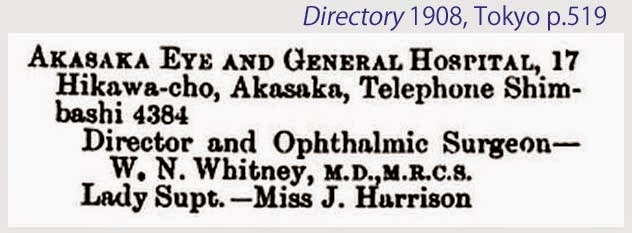
1908: Akasaka Eye and General Hospital
The name has became more simple.


Akasaka Hospital

1917: Akasaka Hospital
No more Willis. William Russell Watson is the director. 


1920: Akasaka Hospital
No doctor's name is mentioned. 


1922: Akasaka Hospital
George Braithwaite, Willis' brother-in-law is an honorable treasurer. The Directory said that there were two of hospital for foreigners in Tokyo, Akasaka and St. Luke's.


In Japanese

 赤坂病院・赤阪病院 

Then, how about Japanese name of the hospital?
It seems that they were always called Akasaka Hospital 赤坂病院 in Japanese. The following image is from an ad at a newspaper, dated 15 December 1892. It reads: 
電話九六九番 内外國醫學士出張
診察自前八時至十一時 日曜休 赤坂區氷川町 赤坂病院
[ Telephone 969 / Doctors holding degrees of in and outside Japan make house calls / hours eight to eleven except Sunday / Akasaka Hikawa-cho Akasaka Hospital ]


出典:明治25年12月15日付東京朝日新聞朝刊6頁

Nothing mentioned about what kind of examination they offered, though, they made house calls. Tne next image is from a medical guidebook of Tokyo, Tōto no Kyōrin, publised in 1902.


田中義一 編『東都の杏林』医海時報社 1902 / pp.26
http://dl.ndl.go.jp/info:ndljp/pid/778437/32

赤坂區
●赤阪病院 氷川町十七番地 新橋九六九
院長ドクトル ホイトニー氏、内外科。
[ Akasaka ward / Akasaka Hospital /  17 Hikawa-cho Akasaka / Shimbashi 969 / Director Dr. Whitney / medicine and surgery ]

The hospital name described 「赤」 not 「赤」 (阪 and 坂 have the same pronounciation). Is this a misprint? I'm not sure. 「内外科」 meas “medicine and surgery”, there is no mention of ophthalmology. I think this guidebook is not very trustworthy.

The last image I am mentioning is from a telephone directory of Tokyo published in 1926.


出典:東京電話番号簿(大正15年5月1日現在) 「あ」の項目のPDF

It reads 「赤坂病院 青山36-5406 赤、氷川、五」. Pay attention to the address is 5 Hikawa-cho, not 17 Hikawa-cho. 5 Hikawa-cho, just around the corner of no. 17, was where George Braithwaite lived then.


Images are cut out and processed by the editor.
Thanks for the those prepared the original data on the net.


Last updated 25 Jan. 2015

2014-12-03

Place In Memoriam - Akasaka Church

赤坂病院内部で持たれていた礼拝会が、基督友会所属の教会を経て、現在の日本キリスト教団赤坂教会となりました。その軌跡を年鑑などの史料からたどります。


from Directory1908 , p.519

The Akasaka Hospital respected cure of souls, as well as of bodies. In the waiting room a short meeting was held each morning for the patients and hospital staff. Meetings were also held on Sundays and Bible Class on Wednesday evenings. The following image is from Japan Sunday School Year Book, published in 1924, which including Akasaka Hospital Sunday school.


日本日曜学校協会編『日本日曜学校年鑑』日本日曜学校協会 1924
http://dl.ndl.go.jp/info:ndljp/pid/969650/63
 赤坂区のリストに、「赤坂病院日曜学校」が入っている
責任者は堀口昌雄


After stopping their medical activities, this spiritual congregation became a  ホイトニ記念赤坂福音会 Whitney Memorial Akasaka Evangerical Meeting in 1921, then 基督友会赤坂福音会 Akasaka Evangerical Meeing of the Society of Friends (Quakers) on December 1939.


東京市赤坂区編『東京市赤坂区勢要覧 昭和12年版』1937
http://kindai.ndl.go.jp/info:ndljp/pid/1463053/43
区内の基督教会リストに
フレンド派 ホイトニ記念赤坂福音会」が見える
信徒数は67名


上記の資料は1937年の段階で「フレンド派」=基督友会に帰属していたことを示している。ただし、財産を法的に移行したのは1939年12月のことで、『基督友会五十年史』には「基督友会社団は赤坂病院清算人よりホイトニー記念赤坂福音会及び医療事業の為め、土地建物並に基金の希望条件付譲渡を受く」とある [p.153]。また、 『基督教年鑑 昭和16年版』の「日本基督友会」の項目には、以下のような説明がある。
昭和十四年〔1939年〕度特殊情勢の一は赤坂福音会の合併なり。赤坂福音会は明治十九年以来、ドクトル・ホイトニー氏のが赤坂病院医療伝道として経営したるものなるが、同病院閉鎖後、その財産の一部を赤坂福音会伝道寄金として、基督友会社団に委託し、其の事業を継続したるが、今基督友会赤坂福音会として、名実共に基督友会に合したるものなり。[新字・新かなに直して引用。出典は p.56 ]


 ↑『基督教年鑑 昭和16年版』日本基督教聯盟年鑑部 1941
http://kindai.ndl.go.jp/info:ndljp/pid/1139414/87
日本基督教団成立直前の1941年4月に出た年鑑。
都内の基督友会聖坂赤坂の2箇所


Then the day of 24 June 1941 came. Almost all of Japanese Protestant religious bodies including the Friends, were forced to merge making one union by the Japanese government. As result of merger, the United Church of Christ in Japan (UCCJ or the Kyodan, 日本基督教団) born. 赤坂氷川町教会 Akasaka Hikawa-cho Church had to belong to them.


『日本基督教団年鑑 昭和18年版』日本基督教団出版局 1943
http://kindai.ndl.go.jp/info:ndljp/pid/1115887/44
東京教区・東京第一分教区に
赤坂氷川町教会が掲載。教役者は「工藤てい」師 ↓


教団に所属したおかげで、戦争中の教勢がわかります。
関心のある方はクリックしてご覧ください ↓
(同じ友会の聖坂も同一ページに掲載)
http://kindai.ndl.go.jp/info:ndljp/pid/1115887/92


After the war, many churches defected from the UCCJ to reestablish their prewar denominational identities. However, Akasaka Hikawa-cho Church chose to remain the UCCJ, which is still the largest Protestant organization in Japan. This means they are the Friends no more.

↓ キリスト新聞社『キリスト教年鑑 1948年版』
http://kindai.ndl.go.jp/info:ndljp/pid/1123634/118 
日本基督教団・東京教区第五分区に
赤坂氷川町教会の名前が見える
教役者は戦前と同じく「工藤てい」師


The church dropped Hikawa-cho from their name in 1966, when the geographical names changed in this area, and the town-name Akasaka Hikawa-cho disappeared. As for the church building, it was burnt down by the air raid on 25 May 1945. It was rebuilt in 1952, and the present building was constructed in 1982.  


On the foundation stone of the church building it reads:
定礎
日本基督教団赤坂教会
ホイットニー記念 1982.1
Akasaka Church, the United Church of Christ
Whitney Memorial, January 1982

The church is located where Akasaka Hospital used to be - 17 Hikawa- Cho, Akasaka-Ku, Tokyo. It is a visible memorial of the Hospital.


Akasaka Church
6-9-6 Akasaka, Minato-ku
Tokyo, 107-0052 Japan
Official site http://www.akasakachurch.com/ ]
* photos of the foundation stone and church building taken by the editor


Images from books are cut out and processed by the editor.
Thanks for the those prepared the original data on the net.


Last updated 10 Jan. 2015